
Parashat Va’Etchanan Deuteronomy 3:23-7:11
Shabbat Nachamu, First Haftarah of Comfort Isaiah 40:1-26
Dear TBE Community,
The Three Weeks are behind us, and with them the somber holiday of Tisha b’Av. Soon it will be followed by Tu b’Av, the fifteenth day of the month of Av (this year on July 28/29), often referred to as the “Jewish Valentine’s Day”, when the unmarried daughters of Jerusalem would go into the vineyards and orchards dressed in white, dancing, eyeing the city’s bachelors – a biblical Jewish singles dating event, and still today an opportunity to bring together young Jewish adults looking for a partner.
Joyful anticipation mixed with inward reflection fills the next weeks on the Hebrew calendar – today is the first Shabbat of seven “Shabbatot of Consolation” that remind us that the High Holidays are beckoning on the horizon. Yes, like every year, it is real and we are completely unprepared! Though one thing you can do to feel a bit more prepared is renewing your membership in time for Rosh Hashanah and to consider spending the High Holidays with us here at Temple Beth El!
Last week I wrote about the balance between mourning and joy, loss and potential, and the power of reviewing one’s own narrative. This Shabbat, the liturgy invites us to live all of these things: As I said, it is Shabbat Nachamu, and this Shabbat of Consolation falls on Parashat Va’Etchanan, which means “And I pleaded” in Hebrew. Heartache and comfort intertwined.
It is the passage in which Moses recounts his version of why he was deprived to go touch the promised land with his own soles and palms. He tells the Israelites how he pleaded with God to not take that away from him. But as we know, his plea was not heeded, Moses did not go. There’s a lot of midrashic literature explaining why Moses found comfort in his lot after all, yet viscerally, they either feel patronizing or just not convincing. If one longs to experience something and does not in one’s lifetime, everything else can feel like second best.
Nevertheless, there is a lesson here, in acceptance, or dignity, or loyalty. After recounting his pain about his unheard plea, Moses repeats the Ten Commandments – slightly different from the first version in Exodus, again, and he imparts the words of Shema: God is one, and you shall love God.
Maybe he wants to reassure himself that his life’s work was not in vain, that even if he didn’t get what he set out to get he still did the right thing. That abandoning what had sustained him for the latter part of his life span was not an option.
This passage is also a good textual and visual reminder that Shema and Ve’Ahavta are one, like God is one. There’s an uninterrupted flow between these cornerstones of our liturgy, between Deuteronomy 6:4-9:
“Hear O Israel, The Lord our God, the Lord is One. You shall love God, your God, with all your heart and with all your soul and with all your might. These words which I command you today shall be upon your heart and teach them diligently to your children and speak of them when you sit in your house and when you walk upon the way; when you lie down, and when you get up. And bind them as a sign upon your hand, and they shall be frontlets between your eyes. And write them upon the doorposts of your house and upon your gates.”
I am in my parents’ house this Shabbat, and I feel comforted by having them around, though visiting Germany is always a bit nostalgic, too: Each year I find myself internally pleading that there may be a next year in which I can return and be like a child when I lie down and wake up. The days always go by too quickly, and this preemptive sensation of loss always reminds me of the cost of immigrating and pursuing one’s calling in a land far away from one’s native land, one’s parents’ house.
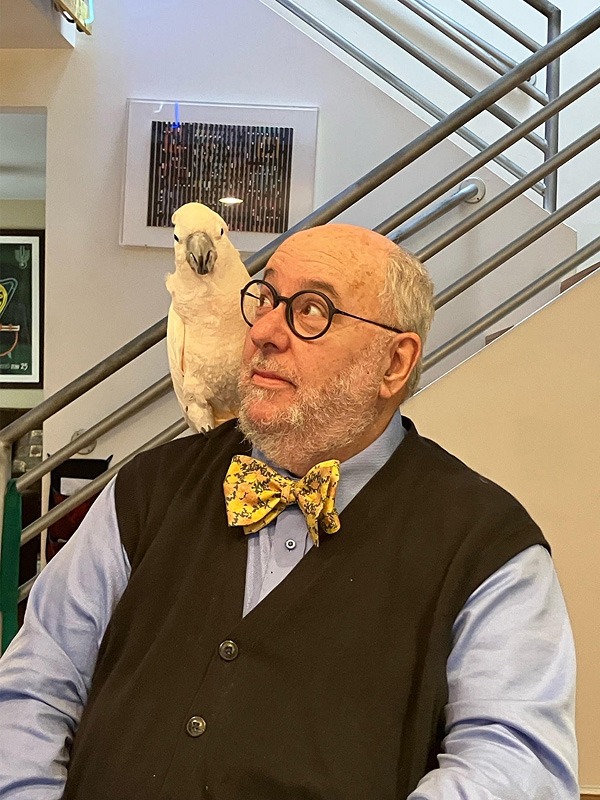
Because I am still in Germany, for this Shabbat at Temple Beth El, I have invited my good friend and rabbinic mentor Rabbi Dan Shevitz to join Cantor Ilan on the bimah as a guest darshan, a guest speaker to give the Dvar Torah in my stead. Some of you will remember Rabbi Shevitz from my installation – and whether you remember him or not, you will be in for a treat. After many years of serving as Senior Rabbi, he is today Rabbi Emeritus at Mishkon Tephilo in Venice Beach. He also serves on the Sandra Caplan Community Beit Din up at the former AJU Familian Campus (or the former UJ Campus, depending on how long you’ve lived in the LA area). And last but not least, he’s the owner of my soul animal, cockatoo Humu, who won’t be joining for services, but I am attaching a photo of her below!
Please welcome Rabbi Shevitz with the open hearts and minds that TBE is so well known for.
I so look forward to seeing you again next Friday for our annual Beach Shabbat.
From Ettlingen, Germany: Shabbat Shalom!
Rabbi Julia Knobloch